
Great Companies, Falling Stocks: Why Investors Must Think Five Times Before Buying an IPO
By: Javid Amin | 20 October 2026
India’s stock market is preparing for another major investment event as Jio Platforms gets ready to open its initial public offering (IPO) on October 21. Backed by Reliance Industries and major global technology investors, Jio has become one of the most closely watched names in India’s digital economy. Its proposed IPO, with a price band of ₹1,065–₹1,119 per share, is expected to raise up to ₹30,213 crore, according to reported offer details.
For investors, the excitement is understandable. Jio transformed India’s telecom market, built an enormous customer base and expanded its ambitions across digital services, cloud computing and artificial intelligence. A company with such a visible presence naturally attracts attention when it enters the stock market.
But there is a question every investor should ask before applying: Does a great company automatically make a great investment at the price being offered?
Recent performance across India’s blue-chip market offers a timely reminder that the answer is no. Tata Consultancy Services (TCS), Infosys, Hindustan Unilever (HUL) and Asian Paints are established businesses with substantial market positions. Yet all four have faced significant share-price declines, according to a recent Economic Times market analysis.
Their experience highlights a basic but frequently overlooked principle of investing: a strong brand, a trusted promoter, a large customer base or an exciting growth story cannot guarantee attractive returns for shareholders.
The lesson matters even more during an IPO, when expectations are high, headlines are enthusiastic and investors may feel pressure to act before the opportunity disappears.
New IPOs bring new hopes. But the market rewards the price investors pay, the earnings a business delivers and the risks they are willing to accept—not simply the popularity of a company.
India’s blue-chip stocks deliver an important investment lesson
The term blue chip often suggests stability, financial strength and a proven business model. Such companies may have established customers, extensive distribution networks, strong balance sheets or leadership positions in their industries.
These qualities matter. They can help a business survive economic downturns, compete against new entrants and generate profits over long periods.
However, a company’s business performance and its stock-market performance are two different things.
A business can continue operating successfully while its share price declines because investors had previously expected even faster growth. A company may increase profits but still disappoint the market if those profits fall short of forecasts. A stock can also lose value when investors decide that its earlier valuation was too high.
That distinction is central to understanding the recent weakness in several Indian large-cap stocks.
A market analysis published by The Economic Times on October 14, 2026, citing ACE Equity data, reported approximate five-year price declines of 42% for TCS, 39% for Infosys, 32% for HUL and 30% for Asian Paints. The same report said the average decline across a broader group of nine large-cap stocks was around 22%.
Reported five-year share-price declines
Figures reported by The Economic Times on October 14, 2026; approximate historical price performance, not a forecast.
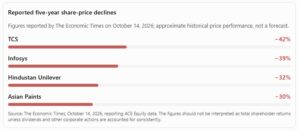
These numbers are a reminder that an established company is not immune to market corrections. They do not, by themselves, prove that the businesses have permanently deteriorated, nor do they establish that their shares are now cheap.
The critical question is what has changed—and what the market may already have priced in.
Why strong companies can become disappointing investments
1. Slower earnings growth can change the entire investment case
Stock prices reflect expectations about future earnings, not merely a company’s past achievements.
Consider a company whose profits have grown rapidly for several years. Investors may begin to assume that the same pace will continue, and the stock may command a premium valuation.
If growth subsequently slows, the market may reassess that premium—even when the business remains profitable.
This is particularly relevant to India’s large information technology companies. TCS and Infosys operate in a sector undergoing changes in enterprise technology spending, artificial intelligence, cloud computing and digital transformation.
AI creates opportunities for technology service providers to develop new products, automate processes and serve clients more efficiently. But it also creates uncertainty. Customers may expect lower prices for traditional services, while automation could change how much labour is required for certain projects.
As The Economic Times reported, analysts remain divided over whether large IT companies can turn AI-related opportunities into new revenue quickly enough to offset potential pressure on traditional services, realisations and margins.
For investors, the right question is not simply whether an IT company will survive the AI transition. It is whether the company can generate sufficient earnings growth to justify its share price.
2. Valuation matters—even when the business is excellent
Imagine two investors buying shares in the same company.
One buys at a reasonable price when expectations are modest. The other buys after years of strong performance, when the stock is priced for continued rapid growth.
Both own the same business. Yet their investment outcomes can be very different.
This is the effect of valuation.
A price-to-earnings ratio, or P/E ratio, compares a company’s share price with its earnings per share. A high P/E can be justified when a company has durable competitive advantages, strong growth prospects and reliable cash generation. But the valuation leaves less room for disappointment if future results fall short.
A lower P/E may indicate a more attractive opportunity. It may also reflect slower growth, rising competition, deteriorating profitability or substantial business risks.
The crucial distinction is between a stock that has fallen in price and a stock that has become undervalued.
A falling share price is a signal to investigate, not a buy recommendation.
3. Competition can weaken even established market leaders
Market leadership is valuable, but it is not permanent.
Companies must continually defend their pricing power, distribution networks, customer relationships and ability to innovate. When competitors introduce better products, offer lower prices or gain access to new distribution channels, even a respected market leader may face pressure.
Asian Paints illustrates this challenge. Its established brand and distribution network remain important strengths, but the company faces greater competition and pressure to demonstrate that growth can recover without a lasting deterioration in profitability.
For HUL, the investment debate is different. The market is looking for evidence of stronger consumer demand and volume growth, alongside the company’s ability to manage input costs, premiumisation and margins.
The broader lesson is that yesterday’s competitive advantage should never be treated as an unconditional guarantee of tomorrow’s profits.
4. Investor sentiment can move faster than business fundamentals
Markets do not operate on financial statements alone. Expectations, liquidity, interest rates, global events and the popularity of investment themes also influence prices.
When investors favour high-growth sectors, established companies may fall out of favour even if their underlying businesses remain sound. The reverse can happen when market enthusiasm shifts back towards large, established businesses.
This creates opportunities, but also traps.
Investors who buy solely because a stock has fallen may mistake a temporary sentiment-driven decline for a fundamental bargain. Others may sell a sound business during a period of pessimism without considering its long-term earnings prospects.
The sensible response is neither blind optimism nor automatic pessimism. It is to examine the evidence.
Jio IPO 2026: A major opportunity, but at what price?
The upcoming Jio Platforms IPO brings the difference between a successful business and an attractive investment into sharp focus.
According to Reuters’ October 14 report, Jio Platforms is seeking a valuation of up to $108.3 billion, with an offer price band of ₹1,065–₹1,119 per share. The offer is scheduled to open on October 21 and close on October 23, 2026. Reuters reported that the company plans to use a substantial portion of the proceeds to repay or prepay borrowings at its telecom subsidiary.
These are significant numbers. But an IPO valuation is not a prediction of how a share will perform after listing.
What makes Jio attractive to investors?
Jio entered India’s telecom market in 2016 with an aggressive pricing strategy that transformed access to mobile data. Its scale, network infrastructure and customer relationships have given it a central position in India’s digital economy.
Reuters reported that Jio’s telecom business had 533 million subscribers and accounted for approximately 60% of India’s data traffic at the time of its October 2026 report. The business has also expanded its ambitions across cloud services, enterprise technology and AI-related opportunities.
For long-term investors, these characteristics may support a compelling growth case:
-
Scale: A large customer base offers opportunities to increase revenue from existing users.
-
Monetisation: Higher average revenue per user (ARPU), additional services and enterprise offerings could improve revenue per customer.
-
Digital expansion: Cloud, AI and other technology services may create additional sources of growth.
-
Financial flexibility: IPO proceeds directed towards debt repayment could help reduce borrowing pressure at the telecom subsidiary.
These are potential strengths, not guaranteed outcomes. Investors must examine whether the expected benefits are already reflected in the offer price.
The valuation question investors cannot ignore
A large customer base does not automatically translate into high profits. Revenue growth must eventually support earnings, operating cash flow and returns on invested capital.
For Jio, one important question is whether it can increase revenue per customer while retaining users and maintaining competitive strength. Another is how successfully it can convert its technology ambitions into profitable businesses.
Regulatory considerations also matter. Reuters reported that Jio’s updated prospectus highlighted potential risks arising from India’s data-protection and telecom rules, including possible limits on data-driven monetisation.
Investors should also understand what the IPO valuation implies about future performance.
If the market price assumes rapid earnings growth for many years, even a successful business may deliver disappointing returns if growth falls short of those expectations. Conversely, a company that performs better than a conservative valuation implies may reward shareholders over time.
The challenge is not to predict whether Jio will succeed as a business. It is to determine whether the price offered provides a reasonable return for the risks involved.
Heavy subscription demand is not a guarantee of profit
Interest from large institutional investors can generate confidence in an IPO. However, demand for shares during an offering and the long-term value of those shares are different things.
Reuters reported that Jio’s offer would rank among India’s largest IPOs, while its listing could place it among the country’s most valuable listed companies.
Even if an IPO attracts strong demand, several outcomes remain possible:
-
The stock may list above the issue price.
-
It may list close to the issue price and move sideways.
-
It may list below the issue price.
-
It may rise initially but subsequently decline as investors reassess earnings or valuation.
Institutional participation, media coverage and the reputation of the promoter cannot eliminate these risks.
The Securities and Exchange Board of India (SEBI) specifically encourages investors to understand IPOs, review offer documents and avoid making decisions based on fear of missing out or listing-day excitement.
The practical lesson is straightforward: subscription figures indicate demand for an offering; they do not guarantee the return an individual investor will earn.
What investors should learn from TCS, Infosys, HUL and Asian Paints
The recent performance of four prominent blue-chip stocks offers a useful framework for evaluating a new listing. Each company operates in a different industry, but their experience points to the same underlying issue: investors must assess future earnings and valuation rather than rely on reputation alone.
TCS: Can AI create enough new growth?
TCS has an established enterprise technology business, but the market must assess how AI adoption will affect demand for traditional services, pricing, margins and future growth. The key question is whether new AI-related opportunities can offset pressure on existing revenue streams.
Infosys: Growth expectations still matter
Infosys operates in the same broad technology-services environment. A recovery would depend on factors such as client spending, new deal conversion, revenue growth and margin resilience. Investors should distinguish a temporary slowdown from a more lasting change in the economics of the sector.
HUL: Strong brands need healthy demand
HUL’s consumer brands and distribution network are important strengths, but shareholder returns depend on factors including volume growth, consumer demand, pricing, input costs and margins. A trusted household name is not insulated from changing purchasing patterns or slower consumption.
Asian Paints: Market leadership must be defended
Competition and pricing pressure can challenge even an established market leader. Investors need to assess whether the company can protect market share, sustain profitability and deliver volume growth without excessive spending or discounting.
These examples do not establish that the four stocks are poor investments today. Nor do they establish that a turnaround is imminent.
They show why investors must look beyond a company’s historical reputation and examine its current business conditions, future earnings prospects and market valuation.
Five questions to ask before investing in any IPO
A new IPO can look attractive because of its brand, growth story or market attention. A disciplined investor should go further.
1. Is the valuation reasonable?
Compare the IPO’s implied market capitalisation with revenue, earnings, cash flow and the valuations of comparable listed businesses. Understand what future growth the price appears to assume.
2. Are earnings growing sustainably?
Examine historical revenue, profit margins, cash generation and the drivers of future growth. One strong year is not enough to establish a durable trend.
3. What are the biggest risks?
Read the risk factors in the red herring prospectus. Look for regulatory exposure, debt, customer concentration, competition, dependence on key business segments and risks to profitability.
4. What will the IPO money be used for?
Understand the fresh issue, any offer for sale, the intended use of proceeds and how the transaction may affect the company’s financial position. These details can materially change the investment case.
5. Can you tolerate a loss?
Consider your investment horizon, emergency savings, existing portfolio exposure and ability to withstand volatility. Money needed soon should not be exposed to substantial equity-market risk.
These questions are especially important for first-time investors who may be tempted to apply because friends, family members or social media personalities are discussing an IPO.
An investor does not need to participate in every major offering. Missing an IPO is not necessarily a financial loss; investing at an unjustified valuation can be.
Fresh issue versus offer for sale: Why the distinction matters
One detail often overlooked in IPO coverage is how the money raised will be distributed.
In a fresh issue, the company issues new shares and receives the proceeds, subject to the offer’s terms and expenses. The funds may be used for expansion, debt repayment or other stated corporate purposes.
In an offer for sale (OFS), existing shareholders sell some of their shares, and the proceeds generally go to those selling shareholders rather than to the company.
The distinction affects how investors should interpret the transaction. A fresh issue intended to fund productive investment or reduce expensive debt may have different implications from an offering primarily designed to provide an exit for existing investors.
In Jio Platforms’ case, Reuters reported that the IPO involves newly issued shares and that a substantial portion of the proceeds is intended for repayment or prepayment of borrowings at its telecom subsidiary.
That proposed use of funds is relevant to the investment case. But investors must still evaluate the amount of debt, the subsidiary’s financial obligations, future capital expenditure and whether the expected benefits justify the valuation.
Debt repayment can strengthen a balance sheet; it does not automatically make the shares cheap.
Should investors buy an IPO on listing day or wait?
There is no universal answer. The right approach depends on valuation, risk tolerance, investment horizon and the quality of available information.
An investor focused on listing-day gains is making a different decision from someone seeking to own a company for five or ten years.
Short-term trading depends heavily on market sentiment, supply and demand, liquidity and the gap between the issue price and the price at which trading begins. Even a well-known company can experience a weak listing if expectations have become excessive.
Long-term investing requires a different assessment: whether the company can increase earnings and cash flow over time, maintain a competitive position and generate returns that justify the purchase price.
Waiting until after listing may provide additional market information, but it does not guarantee a better entry price. A share can rise sharply after listing or decline substantially. Investors should not assume that either outcome is inevitable.
For a long-term investor, the more useful question is whether the stock is attractively valued relative to its prospects—not whether it is likely to deliver an immediate gain.
A falling stock is not automatically a bargain
One of the most persistent mistakes in equity investing is confusing a lower price with better value.
Suppose a share falls from ₹1,000 to ₹700. It is now 30% cheaper than before. But if the company’s earnings outlook has deteriorated substantially, the lower price may still be too high.
The reverse is also possible. A share may fall because investors have become excessively pessimistic, even though the business remains sound and its long-term earnings prospects are intact.
To distinguish between the two situations, investors should assess:
-
Earnings growth and the credibility of forecasts.
-
Valuation relative to peers and the company’s own history.
-
Cash flow, debt and capital expenditure requirements.
-
Competitive advantages and the durability of demand.
-
Risks that could permanently impair profitability.
-
The difference between temporary market weakness and structural business deterioration.
SEBI’s investor-education guidance identifies market risk, business risk, volatility and liquidity risk among the risks investors should understand before entering securities markets. It also highlights diversification as one way investors can manage exposure.
A sound investment decision therefore requires more than spotting a large percentage decline or recognising a famous company name.
What the five-year performance figures do—and do not—tell us
The reported declines in TCS, Infosys, HUL and Asian Paints provide useful context, but they need to be interpreted carefully.
First, historical share-price changes are not the same as total shareholder returns. Total returns account for dividends and may also need to reflect stock splits, bonuses and other corporate actions. A comparison should use a consistent methodology.
Second, a five-year period captures a particular market cycle. Changing interest rates, earnings expectations, sector preferences and company-specific developments can all influence the result. A different starting date can produce a materially different performance figure.
Third, past underperformance does not predict a future recovery. A stock that has fallen substantially can fall further, remain stagnant or recover. The outcome depends on future business performance and the valuation investors are willing to pay.
Finally, these percentages are not a direct comparison between the four blue-chip companies and Jio’s proposed IPO. Jio’s offer price represents a valuation at the time of issuance; its future share-price performance will depend on its own financial results, risks, market conditions and investor expectations.
The useful connection is not that Jio will repeat the performance of these stocks. It is that every investment, whether an established blue chip or a newly listed company, must be judged on its own merits and price.
The long-term investor’s advantage: Discipline over excitement
The stock market will always produce new stories, celebrated companies and apparently unmissable opportunities. Some will become successful long-term investments. Others will disappoint even when the underlying businesses remain prominent.
Investors cannot control market sentiment or guarantee the timing of a recovery. They can, however, control the quality of their research, the price they are prepared to pay, the size of their positions and the amount of risk they accept.
A practical investment process includes reading the prospectus, understanding the business model, comparing valuation with earnings potential, assessing downside scenarios and avoiding excessive concentration in a single company or sector.
It also means accepting that sometimes the best decision is to wait.
An IPO application should not be driven by the fear that everyone else will make money while you miss out. Nor should a falling blue-chip stock be purchased simply because its previous high appears far away.
Good investing is not about predicting every market move. It is about making decisions in which the potential reward reasonably compensates for the risk.
The bottom line: Think five times before investing
Jio Platforms’ IPO is a major event for India’s capital markets, and the company’s scale and digital ambitions make it worthy of serious attention. But investor enthusiasm should be matched by equally serious financial analysis.
The experience of TCS, Infosys, HUL and Asian Paints demonstrates that established businesses can underperform when growth slows, competition intensifies or valuations reset. Their price declines do not automatically make them bargains, just as Jio’s brand strength does not automatically make its IPO a profitable investment.
Before investing in any new IPO, ask five questions: Is the price reasonable? Are earnings likely to grow? What could go wrong? How will the capital be used? And can you afford the potential loss?
The answers matter more than the headlines.
A great company can create wealth, but only when the business delivers and the price paid makes sense. The smartest investor is not necessarily the one who applies first—it is the one who understands what they are buying.
Follow Us on WhatsApp
Get Breaking News, Exclusive Updates & In-Depth Analysis from Kashmir and beyond, delivered straight to your phone.
Join our WhatsApp Channel: Follow Now